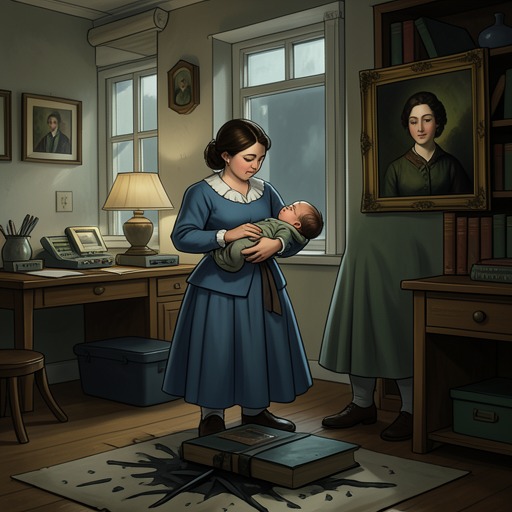
Beth’s death
Little WomenBeth’s death is the central private tragedy of the March family’s later life: a loss that seems to empty the household, yet ultimately confirms the value of a life devoted to music, service, affection, and humble faithfulness. Her passing is presented as both an irrevocable separation and a continuation of love, changing Josephine March’s ambitions and teaching the surviving family members to carry grief through work, tenderness, and remembrance.
The Family World Before the Loss
Beth’s death gains its force from the March family’s long habit of meeting hardship collectively. During the war, the sisters understand that their father, Mr. March, is absent in a military setting and may remain away for a long time. Margaret March explains that the family should surrender Christmas pleasures because the country is enduring a difficult winter and men in the army are suffering. The sisters’ small sacrifices are therefore linked to a wider ethic of service rather than treated as mere deprivation. Mr. March’s decision to serve as a chaplain, despite being too old for the draft and not strong enough to be a soldier, gives the household’s domestic sacrifices a specific moral and historical context.
The family’s strength also depends on emotional discipline. When Josephine March struggles with violent anger, Mrs. March explains that self-control is not the absence of anger but the result of lifelong effort. She admits that she has been angry nearly every day of her life and has learned to restrain the words that would otherwise escape her. Her method is practical: when anger threatens to break out, she leaves the room briefly and gathers herself. This model of imperfect but persistent self-command becomes important after Beth’s death, when grief cannot be eliminated and must instead be borne, shared, and redirected.
Care is likewise shown as an active duty. When a telegraph announces that Mr. March is very ill, Mrs. March immediately prepares to travel to him, while the daughters gather supplies, seek wine from James Laurence, and organize the household. She entrusts the girls to Hannah Mullet and James Laurence, instructing them not to become idle or merely try to forget their trouble. Her counsel is to continue their usual work, because work is a blessed solace, and to maintain hope while remaining busy. That principle later becomes a way for Josephine March to survive the vacant house after Beth’s death.
The Final Recognition
Before Beth dies, the emotional meaning of her life is made explicit through a small written testimony. The lines are blurred, faulty, and feeble, but they bring unmistakable comfort to Beth because they answer her fear that she has done too little. The paper assures her that her life has not been useless and that her death will not produce only despair. Its physical weakness mirrors Beth’s failing body, while its effect is strong enough to alter her understanding of herself.
Beth asks Josephine March whether she has truly been the sister Jo believes her to be. Josephine answers that Beth has meant more to her than anyone in the world. Beth then confesses that she is comforted by knowing she has helped and been loved so deeply. The exchange turns private affection into a final recognition: Beth’s value does not depend on public achievement, wealth, or worldly accomplishment, but on the enduring changes she has made in the lives closest to her.
Beth’s last request gives Josephine a new responsibility. She tells Jo to take her place and become everything needed by Mr. March and Mrs. March after Beth is gone. She acknowledges that Josephine may find such work harder than writing splendid books or seeing the world, but insists that love is the only thing a person can carry when departing life. The statement does not deny Josephine’s artistic ambition; it places that ambition beside a more demanding conception of usefulness. Josephine promises to try, and at that moment she renounces her former ideal of achievement in favor of an ambition shaped by care, family duty, and the immortality of love.
The Course of the Death
Beth’s death unfolds through a gradual seasonal and spiritual passage rather than a dramatic medical crisis. Spring advances around her: the sky clears, the earth grows green, flowers appear, and birds return as if to say goodbye. The narration compares Beth to a tired but trusting child held by the hands that have guided her throughout life. Mr. March and Mrs. March accompany her tenderly through the Valley of the Shadow and surrender her to God, making the family’s care part of a religiously framed passage.
The narrative deliberately resists sentimental spectacle. It observes that dying people seldom speak memorable words, see visions, or depart with radiant faces, and that death generally comes as naturally and simply as sleep. Beth’s end follows that plainness. The tide goes out easily; in the dark hour before dawn, on the breast where she first drew breath, she quietly draws her last breath. There is no formal farewell, only one loving look and a little sigh. The restraint gives the scene its particular power: the death is not made less devastating by being ordinary, but more intimate.
Afterward, Mrs. March and her daughters prepare Beth for burial with tears, prayers, and tender hands. The serenity that replaces her long suffering is perceived with gratitude as well as sorrow. To those who love her, death becomes a benign angel rather than a frightening phantom. The language does not erase pain, but it changes the emotional charge of the room from dread to acceptance.
Immediate Aftermath and Grief
The morning after Beth’s death makes absence visible through altered household details. The fire is out, Josephine March’s place is empty, and the room is very still. Yet a bird sings on a budding branch, snowdrops bloom at the window, and spring sunlight falls across Beth’s peaceful face. Nature continues without denying the loss. Its renewal does not replace Beth; instead, it frames her death as a passage from pain into rest and gives the family a form of blessing through which to look at the body.
Josephine’s grief is not immediately obedient or consolable. She wakes at night thinking that Beth has called her, sees the empty little bed, and cries for Beth to come back. Her sorrow is described as unsubmissive because it resists the spiritual interpretation she has just accepted. The family’s earlier training in work and self-command cannot simply prevent this response. Grief returns in the body, in the bedroom, and in repeated cries, making the loss a continuing experience rather than a single completed scene.
Mrs. March becomes Josephine’s principal comforter. She answers the nighttime sobbing with patient tenderness, tears, and broken whispers rather than with explanations alone. Her own greater grief does not make her distant; it enables a silent communion in which heart speaks to heart. Through these encounters, affliction gradually becomes a source of chastened grief and strengthened love. Josephine’s burden grows lighter, duty becomes sweeter, and life becomes more endurable under her mother’s care.
Family Continuity and Meaning
Beth’s death changes Josephine March most directly, but it also clarifies the structure of the March household. Three years later, the war is over and Mr. March is safely home, serving as a minister to a small parish. Though poverty and strict integrity keep him from worldly success, his wisdom, charity, and piety draw troubled people to him. The women may appear to rule the household in practical matters, but he remains its head, conscience, anchor, and comforter. Beth’s charge to Josephine therefore extends an existing family pattern: love is expressed by assuming responsibility for the people who depend on one another.
The same ethic appears in other domestic relationships. Margaret March learns, during her first serious disagreement with John Brooke, that reconciliation requires her to overcome pride and speak through action. Remembering Mrs. March’s counsel, she crosses the room and kisses her husband’s forehead; the gesture ends the conflict more effectively than a world of words. Later, Mrs. March explains that Margaret has allowed love for her children to eclipse her duty to her husband and urges her to make their home attractive to him rather than permit parenthood to separate the couple. These episodes do not duplicate Beth’s death, but they show the continuing family grammar of the loss: affection must become work, self-restraint, forgiveness, and daily presence.
For Josephine, the most decisive consequence is the redirection of desire. She had feared being confined to a quiet house of humdrum cares, small pleasures, and duties that never became easier. After Beth’s death, those same duties are transformed by the knowledge that they can embody love. Josephine does not cease to be ambitious or creative, but her idea of a worthwhile life is no longer measured only by splendid books or seeing the world. Beth’s final teaching makes care itself a form of achievement, and memory turns the dead sister into a continuing guide rather than a vanished influence.